


 Meh...it was a bit formulaic and a bit like the writer was trying too hard to be original. It was ok, but only just that.

 Initially, the book did nothing for me. As I read it, the disjointed points of view for the first two chapters felt very set apart and with little to tie them together. I didn't like being left of in the midst of the action and then have my attention re-focused on another time, another space and another set of characters. But, with time and with more chapters, there were more layers and more links between the characters. It actually came together rather spectacularly in the last third of the book. That's when I fell in love.The blurb on the back of the book talks about Sasha and Bennie and following them through time, as they interact with the different people in their lives. But this book is so much more than that. It's also about Rhea and Allison and Lulu and Dolly and Alex and Lou and Rolph and plenty of other characters. It was really well written, with all the shimmering threads (spider's web?) that connect some of the characters to each other being revealed and followed. Except that I would have liked a chapter just on Rolph. That's my main complaint. Otherwise...if you can stand the first 4 or 5 chapters, this might be the book for you.

 I don't normally read spy thrillers, but after this book, I'm certainly going to read more by John le Carré. This is a relatively short book that packs a lot into its 230 pages. Alec Leamas is trying to leave the work of espionage and "come in from the cold". The book walks us through his attempt and, I swear, I really didn't see the end coming until about 2 pages before the end. It was fabulous. I really enjoyed it.
 1
1

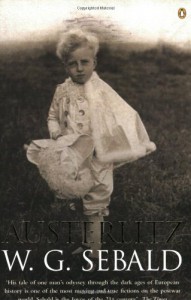 Austerlitz is not an easy read. A book that spans over 400 pages, with no chapter breaks or paragraphs. It's one long stream of consciousness, except that it's not. But it is a book that benefits from long, uninterrupted reads. Reads that I do not get. So that's my only quibble with the book; a quibble that's more due to my life than the book itself.Austerlitz follows the encounter of our unnamed narrator with Jacques Austerlitz, one of the children on the kindertransport out of war-torn Europe to the relative safety of the UK. As soon as the four year-old Austerlitz gets to his British family, in Wales, they strip him of his identity and give him a new name. Growing up in the cold (both physically and emotionally) house in Bala with two distant adults for company, Austerlitz stagnates. Only the escape to a boarding school brings him some satisfaction, to the point where the loathes going home at holidays. It's during his time at the boarding school that he first finds out that his actual name is very different from the one he has been using for much of his life.Our narrator encounters Austerlitz infrequently, but each time the story picks up without introductions or unnecessary small talk. Slowly, through the meandering tale that he tells, we find out about his past. Or rather, what Austerlitz found out about his past. The tangents and extra information are wonderful snippets of a great mind, but I can see how these would be irritating to some readers. We find out parts of his past gradually, but there's no happy ending there. I preferred it that way; a happy ending in such a book would seem forced and fake. Instead, some of the threads are left open with hints as to what happened. This is a brilliant book, but it isn't for everyone. The lack of structure, or the seeming lack of structure, will put some people off. I really wished that I could have gone away for a few days, sat down and read the book without the interruptions that my life contains. It would have been a far more satisfying way of reading the book.
1
Austerlitz is not an easy read. A book that spans over 400 pages, with no chapter breaks or paragraphs. It's one long stream of consciousness, except that it's not. But it is a book that benefits from long, uninterrupted reads. Reads that I do not get. So that's my only quibble with the book; a quibble that's more due to my life than the book itself.Austerlitz follows the encounter of our unnamed narrator with Jacques Austerlitz, one of the children on the kindertransport out of war-torn Europe to the relative safety of the UK. As soon as the four year-old Austerlitz gets to his British family, in Wales, they strip him of his identity and give him a new name. Growing up in the cold (both physically and emotionally) house in Bala with two distant adults for company, Austerlitz stagnates. Only the escape to a boarding school brings him some satisfaction, to the point where the loathes going home at holidays. It's during his time at the boarding school that he first finds out that his actual name is very different from the one he has been using for much of his life.Our narrator encounters Austerlitz infrequently, but each time the story picks up without introductions or unnecessary small talk. Slowly, through the meandering tale that he tells, we find out about his past. Or rather, what Austerlitz found out about his past. The tangents and extra information are wonderful snippets of a great mind, but I can see how these would be irritating to some readers. We find out parts of his past gradually, but there's no happy ending there. I preferred it that way; a happy ending in such a book would seem forced and fake. Instead, some of the threads are left open with hints as to what happened. This is a brilliant book, but it isn't for everyone. The lack of structure, or the seeming lack of structure, will put some people off. I really wished that I could have gone away for a few days, sat down and read the book without the interruptions that my life contains. It would have been a far more satisfying way of reading the book.
1

 Pat Peoples comes out of the "bad place" and moves back in with his parents. Pat has mental health problems and is in the midst of "apart time" with his wife, Nikki. The book follows Pat as he tries settle into his life outside of a psychiatric hospital and to reunite with Nikki by practicing "being kind not right". This is a fantastic book, similar to The Curious Incident of the Dog in the Nighttime. As the story progresses, we find out why Pat was in the "bad place" and what happened between him and Nikki.

 I hated this book. It was only sheer perseverance that kept me going, but there was no enjoyment in the process at all. I was under the illusion that erotica is meant to make you aroused. Sadly, this book did not do the trick. Instead, it reads like it was written by a high school girl, with access to some dirty magazines. I don't know how a sex scenes should be written, but they should definitely not be written like this! The characters are, predictably enough, shallow and underdeveloped. Anastasia is a bookish, shy girl with multiple personality disorder (there is the normal her, the goddess and the sarcastic subconscious). She is corrupted by the evil, cold but handsome and rich Christian. He, of course, has a dark past that has shaped him into the cruel and distant man he is today. He sets about to deflower our heroine and turn her into his submissive. After the first two sex scenes, I pretty much gave up on reading the rest because they were so badly written. This allowed me to move much quicker through the book than I would have otherwise done, as I really didn't pick it up very often. The storyline is preposterous and predictable at the same time. Within the first 20 pages, Anastasia keeps telling us that there has never ever never been a man who has made her feel this way, that she's never met a man that she felt so very "whoa!" about and that this sort of behaviour is really not like her at all. She goes on and on and on about this until, as a reader, you sort of want to scream "Enough! I get the point!"There is drama and suspense and the last 5 pages allow for the fastest movement of plot in the whole book. It's almost as if the author had run out of steam or time or energy. But, of course, we need to read the next two books to see what happens to Anastasia and Christian and if their love is true and virtuous after all. But the book spends too much explaining the simple and evident, while leaving our characters dull and two-dimensional. I won't even go into the dialogue and the inner-dialogue Ana has with herself because I might start writing some very angry words. But to keep it simple: the dialogue stinks.If you value your time, I would really not bother reading this book.

 This novel tells the story of Aminiata Diallo, an African woman, abducted and sold into slavery at 11. We follow Aminiata's journey through South Carolina's plantations, New York, Nova Scotia, Sierra Leone and, finally, London. This is a fascinating account of the lives of slaves and the strength of one woman. It is a brilliant book.

 The Sisters brothers are hired mercenaries by The Commodore. They do his dirty work during the Gold Rush of 1851. But along the way, the younger of the two, Eli, begins to question his life and his life of violence. The book takes us along with Charlie and Eli as they chase down a comically-named man, Hermann Kermit Warm, across the Oregon border into California. As the reader, we get a glimpse of the madness that overtook the men and women during the Gold Rush. This is a fantastic book, well-written and funny in places. The underlying sadness of Eli's lack of happiness with his life carries through all the brothers' adventures. This book was shortlisted for the 2011 Booker prize. I've not read the winner yet (The Sense of an Ending) but I'm surprised this one didn't win after all.
1
The Sisters brothers are hired mercenaries by The Commodore. They do his dirty work during the Gold Rush of 1851. But along the way, the younger of the two, Eli, begins to question his life and his life of violence. The book takes us along with Charlie and Eli as they chase down a comically-named man, Hermann Kermit Warm, across the Oregon border into California. As the reader, we get a glimpse of the madness that overtook the men and women during the Gold Rush. This is a fantastic book, well-written and funny in places. The underlying sadness of Eli's lack of happiness with his life carries through all the brothers' adventures. This book was shortlisted for the 2011 Booker prize. I've not read the winner yet (The Sense of an Ending) but I'm surprised this one didn't win after all.
1


 A six-year old girl spends the summers with her grandmother on a small island in the gulf of Finland. The girl's father is there, too, but he's mainly working and a background character. The relationship is not a kissy-huggy one. The grandmother is quite caustic at times and Sophie seems to shout a lot, but I imagine she shouts in the way that children shout: as a form of communication. The beauty of the book is the language and the pace of the plot. Each chapter describes an event during one of the summers: visit from an older friend, a new house built on a nearby island, a ferocious storm that hits the islands in the gulf, etc. The language is beautiful and I could pull out half a dozen quotes out of the book, but this is the one that stayed with me the longest: Sometimes people never saw things clearly until it was too late and they no longer had the strength to start again. Or else they forgot their idea along the way and didn't even realise that they had forgotten. This is an amazing book that will stay with me for a long time.

 Alain de Botton is perhaps the only person who can make the M4 sound even remotely poetic. "Having avoided the earth for so long, wheels that had last touched ground in San Francisco or Mumbai hesitated and slowed almost to a standstill as they arched and prepared to greet the rubber-stained English tarmac with a burst of smoke that made manifest their planes' speed and weight. With the aggressive whistling of their engines, the airborne visitors appeared to be rebuking this domestic English morning for its somnolence, like a delivery person unable to resist pressing a little too insistently and vengefully on the doorbell of a still-slumbering household. All around them, the M4 corridor was waking up reluctantly. Kettles were being switched on in Reading, shirts being ironed in Slough and children unfurling themselves beneath their Thomas the Tank Engine duvets in Staines."When Terminal 5 opened at Heathrow Airport in 2009, Alain de Botton was asked by the company that owns the airport, BAA, to become its first writer-in-residence. In short, de Botton got to hang around the airport for a week, exploring it all and writing about it.What he produced is an amazing testament of love to travel. For all of us who enjoy the thrill of visiting new places despite the hassle of airports and their inconveniences, this is an excellent book. He has made me want to book a ticket for this weekend, just so that I have the chance to travel, to board planes, to go through the well-known steps that accompany modern travelling. As a teenager, I spent years bringing people to the airport and picking them up, without actually flying myself. When I did finally escape the city on the prairies, I flew on planes so often that I got bored with it. Alain de Botton's short book on his time at Terminal 5 is, of course, philosophical about not just travelling, but about life. Our capacity to derive pleasure from aesthetic or material goods seems critically dependent on our fist satisfying a more important range of emotional and psychological needs...We cannot enjoy palm trees and azure pools if a relationship to which we are comitted has abruptly revealed itself to be suffused with incomprehension and tension. So if you love travelling or hate flying or are indifferent to the way an airport runs, you should definitely read this book. It's beautiful.

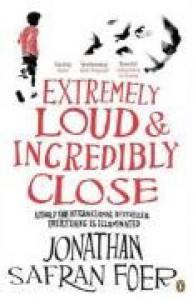 I didn't know what to expect when I picked up the book, but in the early pages I was blown away. Oskar is nine and in search of a lock for a key he found in his father's closet. His father died in the attack on the Twin Towers in 2001. I loved being inside Oskar's mind! To describe him as precocious would be an understatement and there is something almost autistic about his way of thinking. I loved following Oskar around the streets of New York, while wondering what his Mum was up to, allowing him out on his own. I loved the people he met (all those Mr and Mrs and Miss Blacks). What I didn't love was all the background filler in disjointed letters and messages. As I read the other part of the story about Anna and Thomas and Dresden, it all felt a bit too contrived to me. I know that all those strands do come together in the end, but they were more of a distraction. But overall, this book was amazing.

 There are lots of books I've read about World War I and from lots of perspectives. However, I've never read one from the perspective of a horse. Until today. War Horse is the story of Joey and Albert (Joey's the horse) and their friendship. Joey, unfortunately, goes off to World War I without Albert, who is too young at the time. In France, Joey experiences the horrible things that are now associated with World War I: trenches, mud, senseless death, injuries, cold and rain. It is a wonderful book, though at times, the writing was too simple and I had to remember that I was reading a children's book and the language had to match it. It was a very, very interesting read.

 The book's predictable plot is easy enough to follow and the language is interesting and, at times, playful. However, the author set the novel in the modern times but all the British people seem to have attitudes from the 50s. Other than Roger, the annoying financier son, there is little in there that I recognise as being England. Maybe things are a bit more outdated in Sussex. Also, if the Major is all proper British, like, he wouldn't say "cilantro", he'd say "coriander", as he's looking at all the spices Mrs Ali digs out. I know coriander might have the reader scrambling for their dictionary, but if the author tries to make everything "authentic" down to the disgust felt by the Major for a tea-in-a-tea-bag cup of tea, she should remember the correct words for various things. It sounds like I really hated the book when I didn't. I simply thought it ok.

 It was my favourite of the three that I've read, as it finally brought all the threads together and explained exactly what was going on. I spent the first two books being a bit lost and confused and it was nice to have it all explained.

 This was one of those books that I wish went on for another 200 pages. It follows the lives of young students during the Marshal Law in Krakow, Poland. We get a glimpse into what life was like for underground activists at this time. It is a great book, simply written but with multiple perspectives from the lives of the activists. I wish it was available in English to a wider audience.
